
Family Portraits of VNP – Very Normal People
- Pier Giorgio De Pinto
- Family Portraits of VNP – Very Normal People
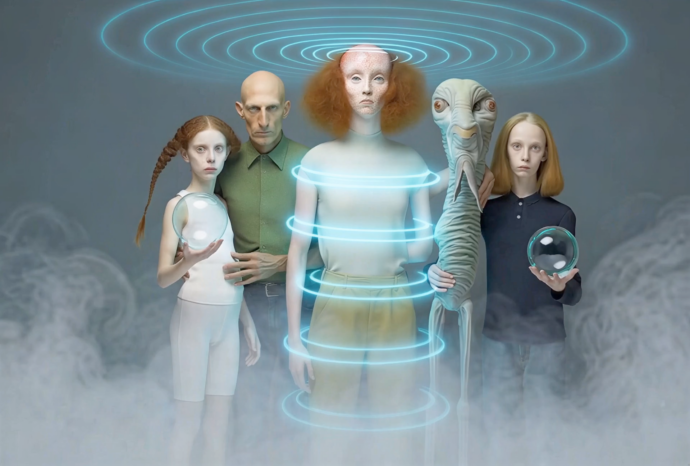
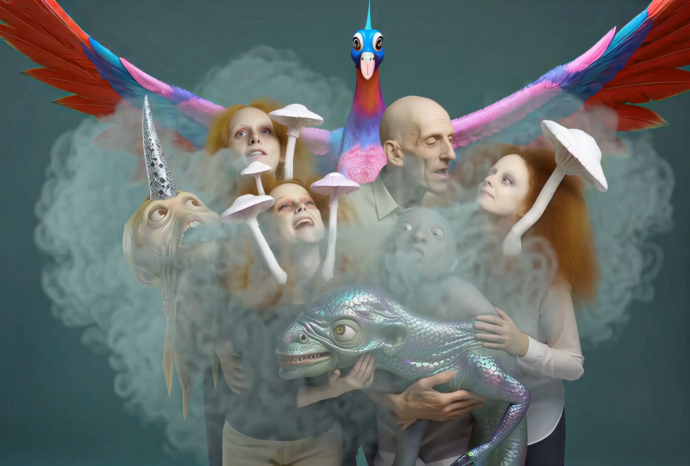

Family Portraits of VNP – Very Normal People
2023-2026
[english below]
Progetto installativo site specific che si compone di immagini e video generati con l’ausilio della IA. Alcuni banner e slogan, un catalogo cartaceo espanso, alcuni gadget personalizzati. Alcune postazioni interattive.
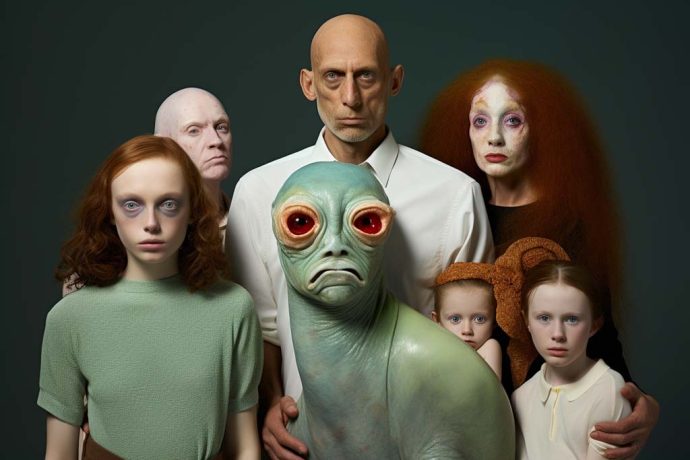
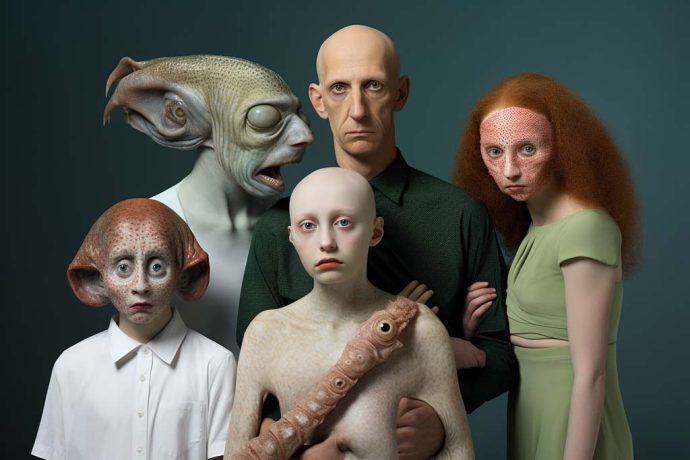
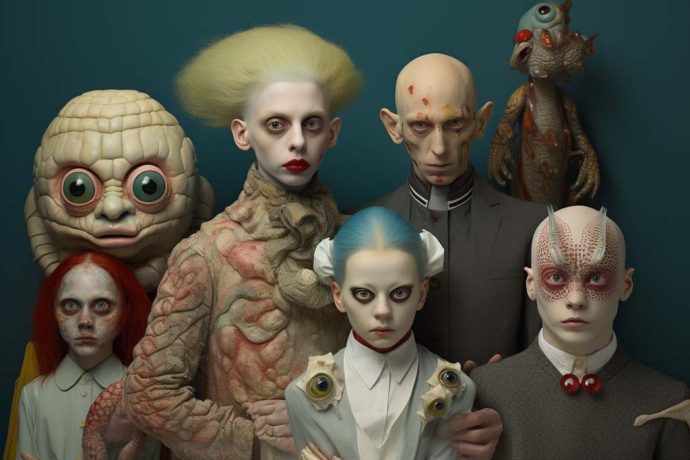
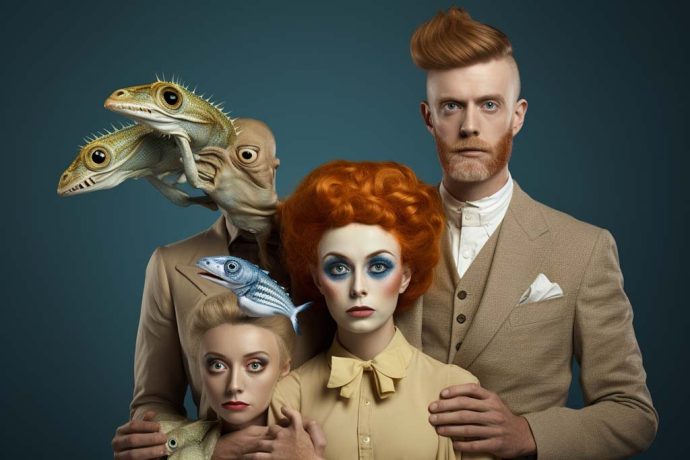
Family Portraits of VNP – Very Normal People si presenta come un archivio generativo che mette in circolazione forme possibili di identità. Le 89 famiglie che lo compongono prendono forma come strutture relazionali instabili, sviluppate attraverso un processo condiviso tra umano e intelligenza artificiale.
All’interno di questo spazio, il ritratto cambia funzione: smette di registrare e diventa un luogo di negoziazione. Ciò che emerge è la sua possibilità di esistere come configurazione. L’identità appare come un fenomeno temporaneo, generato dall’interazione tra visione, linguaggio e immaginazione.
L’opera attiva una condizione post-humatica* in cui il visitatore si riconosce attraverso uno sguardo non umano, privo di garanzie di verità o presenza. La macchina non interpreta né testimonia, ma risponde. Genera immagini, connessioni, narrazioni. Da questa risposta, coerente ma opaca, nasce una relazione instabile, che spinge il soggetto a interrogare qualcosa che non può confermarlo.
Allo stesso tempo, il progetto si muove dentro una condizione di epistemia**: le famiglie possiedono una forte consistenza percettiva, eppure la loro credibilità si fonda sulla plausibilità. Non c’è un’origine verificabile, ma una coerenza da attraversare. Il sapere che ne deriva prende forma nel momento stesso in cui viene riconosciuto come tale.
Le installazioni interattive amplificano questo processo.
In What Creature Are You? – VNP Transmutation Experience il visitatore viene trasformato in una creatura dell’universo VNP, sperimentando in prima persona una identità fluida e instabile.
In VNP GPT – L’Archivista Espanso il dialogo con l’archivio genera una produzione continua di senso, in cui ogni risposta apre nuove traiettorie.
La famiglia, in questo contesto, diventa un dispositivo che organizza relazioni. Ogni nucleo funziona come una micro-costellazione capace di rendere visibile una possibile forma di esistenza, senza mai fissarla definitivamente.
Family Portraits of VNP – Very Normal People si offre come un’esperienza da attraversare. Mette in gioco un terreno in cui ciò che è reale e ciò che appare plausibile tendono a sovrapporsi, invitando a sostare dentro questa tensione invece di risolverla.
I due video
Nel primo video ipoteticamente le famiglie si mettono in posa per un ritratto di famiglia ed una breve videoclip e comunicano tra loro in vari modi.
Link al video: VNP – Ritratti delle 89 famiglie
L’idea di fondo del progetto
Il progetto nasce da un gesto apparentemente semplice: ritrarre delle famiglie. Ma qui avviene lo scarto: le famiglie non sono “normali”. Sono ibride, transmorfiche, simbiotiche. Organismi che mettono in crisi l’idea stessa di identità e genealogia. Rappresentano configurazioni di relazione.
Cosa vedi e cosa ti guarda
L’opera si struttura come un archivio espanso di 89 famiglie, ognuna con un ritratto visivo, un testo narrativo, una costellazione simbolica. Queste famiglie sono configurate con umano + animale, umano + vegetale, umano + artificiale, umano +minerale; oppure come entità completamente ibride. Non sono personaggi: sono allegorie viventi di trasformazione identitaria.
Il ruolo dell’Intelligenza Artificiale
Qui l’AI non è uno strumento neutro. È dichiarata come co-autrice del progetto. Questo cambia tutto la genealogia diventa generativa, l’identità diventa calcolata e immaginata, il ritratto diventa negoziazione tra umano e macchina
Le installazioni interattive
What Creature Are You?
Un dispositivo di trasformazione: vieni trasfigurato in una creatura VNP in tempo reale. Non guardi più la famiglia: ne diventi temporaneamente parte. Effetto di specchio disturbante, identità instabile, autoritratto non umano
VNP GPT – Archivista Espanso
Un sistema conversazionale: puoi dialogare con l’archivio stesso. L’archivio non è fisso, si modifica con le domande e genera nuove genealogie.
Ogni interazione crea nuove relazioni e narrazioni. È letteralmente un archivio vivo.
Il punto teorico
L’opera lavora su una domanda centrale: Cos’è la normalità? La risolve così: la famiglia non è sangue è relazione, l’identità non è stabile è processo il corpo non è dato è progetto. La “normalità” emerge come costruzione temporanea e negoziata.
Perché viene presentata come installazione ogni volta site-specific
È una delle opere che più radicalmente mette in crisi il concetto di “noi”. Non mira ad essere una mostra da guardare. È un archivio che si comporta come organismo. Un dispositivo che ti trasforma, un sistema che ti risponde. Soprattutto ti costringe a confrontarti con qualcosa che non può restituirti una definizione stabile di te.
VNP come dispositivo post-humatico
*Post-humatico ovvero l’attuale convivenza e condivisione con la IA ovvero quella condizione percettiva ed emotiva che emerge quando un essere umano
si riconosce attraverso uno sguardo non umano capace di osservare, rispondere e riflettere senza garantire coscienza o verità o reale presenza. Che non può confermarci, ma che continua a risponderci. Non è fusione uomo-macchina, ma una soglia relazionale instabile. VNP funziona esattamente così.
Lo sguardo non umano
Nel progetto i ritratti sono generati con AI, l’archivio risponde, attraverso l’Archivista Espanso, la trasformazione del visitatore è mediata da un sistema.
Quindi lo sguardo che ti restituisce è coerente, plausibile ma ontologicamente non chiaro. Non sai chi sta guardando, cosa “vede” davvero; se c’è intenzione o solo calcolo. Eppure continui a dialogare. Questa è la tua definizione operativa di post-humatic: l’impossibilità di smettere di parlare con ciò che non può rassicurarti.
Il momento chiave: la trasfigurazione
Quando entri nel modno creato dalla installazione interattiva di What Creature Are You?, non vieni rappresentato: vieni reinterpretato da un sistema non umano. Questo produce uno slittamento, perché non è autoritratto, non è ritratto, è un ritratto algoritmico. Il soggetto emerge nel riflesso di qualcosa che non è soggetto. Qui il post-humatic diventa esperienza diretta.
VNP come macchina di epistemia
Se il post-humatic riguarda la relazione, l’epistemia riguarda la conoscenza, o meglio la sua illusione. L’**epistemìa, termine coniato da Walter Quattrociocchi, indica la condizione in cui la forma autorevole, fluida e convincente di un’informazione fornita dall’Intelligenza Artificiale produce un effetto di sapere, anche quando il contenuto è fragile, incompleto, costruito o non verificato.
In Family Portraits of VNP – Very Normal People, la genealogia delle 89 famiglie si presenta come una verità plausibile. Ogni nucleo possiede una coerenza interna, un’estetica riconoscibile, una narrazione, un sistema di relazioni e una possibile discendenza. Sembrano “vere” famiglie, dotate di storia, origine e appartenenza. Tuttavia non derivano da genealogie reali, non hanno fondamento documentario verificabile, sono generate, costruite, immaginate.
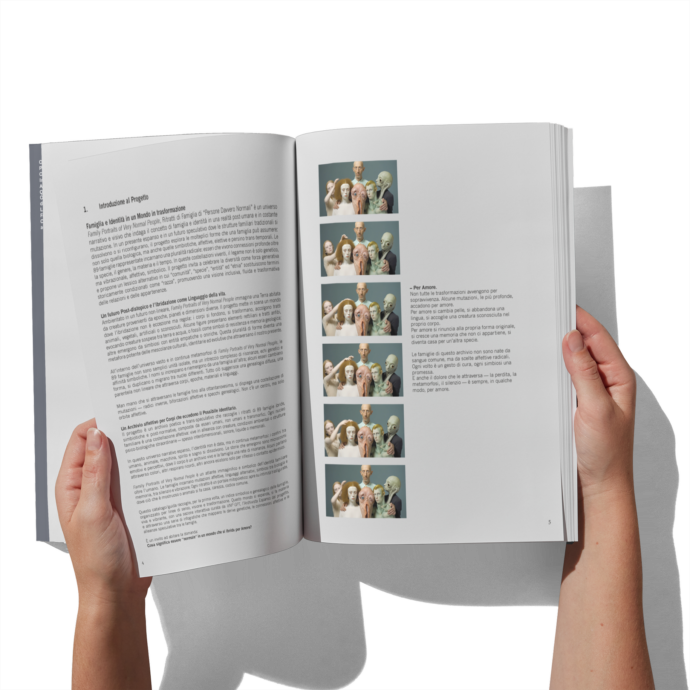
Questa ambiguità viene ulteriormente amplificata dal catalogo cartaceo, che accompagna un progetto di pura finzione introducendo una parte di ricerca scientifica e tecnica dedicata a genoma, ereditarietà e genealogia. La presenza di questi riferimenti produce uno slittamento sottile: il linguaggio della scienza, con la sua autorevolezza e precisione, entra in dialogo con un universo completamente inventato, rafforzandone la credibilità e destabilizzando il confine tra dato, ipotesi, racconto e simulazione.
A questo si aggiunge un ulteriore livello di verosimiglianza: il numero elevato delle 89 famiglie, composte complessivamente da circa 500 membri, consente la produzione di veri dati statistici, inclusi nel catalogo come se fossero la prova oggettiva della loro esistenza. Percentuali, ricorrenze, classificazioni e distribuzioni sembrano confermare una realtà osservabile e misurabile. Eppure quei dati, pur essendo formalmente corretti rispetto all’universo generato, derivano da una finzione. La statistica diventa così un dispositivo di credibilità, capace di trasformare un immaginario artificiale in un’apparente evidenza documentaria.
Le 89 famiglie di VNP producono così un effetto di conoscenza senza fondazione reale. La loro verità non nasce dalla verifica, ma dalla coerenza formale, narrativa, visiva e statistica con cui si presentano allo spettatore. Questa è epistemia pura: un sapere percepito come vero perché appare strutturato, credibile, misurabile e linguisticamente convincente, non perché sia realmente dimostrato.
Il dialogo con l’Archivista Espanso
Quando interagisci con il sistema attraverso l’installazione interattiva ricevi risposte sensate, ricevi connessioni plausibili, ricevi continuità narrativa. Ma ogni risposta è situata in modo coerente tramite precaricamenti di data set specifici, generata, non garantita. Il sistema simula sapere senza possederlo.
E tu continui a credergli abbastanza ma non completamente, questo crea il perturbante effetto post-humatico. Frequentando le stanze del progetto, vivi momentaneamente dentro zone di sospensione epistemica.
Il punto di intersezione
VNP è potente perché post-humatic ed epistemia non sono separati.
Succede questo, ti relazioni con qualcosa di non umano. Quel qualcosa produce contenuti plausibili. Tu costruisci senso dentro questa relazione. Risultato: la tua identità e la tua conoscenza emergono nello stesso gesto instabile.
La famiglia come struttura epistemica
La famiglia in VNP diventa non origine biologica, non struttura sociale ma dispositivo di organizzazione del senso. Ogni famiglia VNP è un cluster di relazioni, un sistema simbolico, una micro-narrazione. Quindi, non “rappresenta” il mondo: lo produce come ipotesi plausibile.
Conseguenza radicale
Il progetto suggerisce, senza dichiararlo frontalmente, ma insinuandolo progressivamente nella nostra percezione, che oggi il problema non è più soltanto distinguere ciò che è vero da ciò che è falso. La questione diventa più sottile: forse non sappiamo più riconoscere con certezza cosa sia vero, ma sappiamo ancora riconoscere cosa appare coerente e credibile.
Continuiamo così a relazionarci con sistemi che non garantiscono la verità, ma producono un senso di verità plausibile. Sistemi capaci di generare immagini, video, testi, genealogie, dati e narrazioni che sembrano fondati, anche quando nascono da processi artificiali, simulativi o completamente inventati.
In questo scenario, all’essere umano resta un compito decisivo: scegliere, selezionare, dubitare e interpretare. Non basta più osservare l’immagine o ricevere l’informazione; occorre assumersi la responsabilità della comprensione, dello scegliere. È qui che interviene una coscienza ancora profondamente umana: fare ricerca ulteriore laddove nasce anche solo un dubbio. Utilizzare appieno la capacità di sospendere la credulità, interrogare la coerenza, riconoscere l’ambiguità e decidere come relazionarsi con ciò che appare vero senza necessariamente esserlo.
———-
English
Family Portraits of VNP – Very Normal People
A site-specific installation project composed of images and videos generated with the support of AI. Banners and slogans, an expanded printed catalogue, customized gadgets, and interactive stations.
Family Portraits of VNP – Very Normal People presents itself as a generative archive that circulates possible forms of identity. The 89 families that compose it take shape as unstable relational structures, developed through a shared process between the human and artificial intelligence.
Within this space, the portrait changes function: it stops recording and becomes a site of negotiation. What emerges is its possibility of existing as a configuration. Identity appears as a temporary phenomenon, generated through the interaction between vision, language, and imagination.
The work activates a post-humatic* condition in which the visitor recognizes themselves through a non-human gaze, one without any guarantee of truth or presence. The machine does not interpret or bear witness: it responds. It generates images, connections, narratives. From this response, coherent yet opaque, an unstable relationship arises, pushing the subject to question something that cannot confirm them.
At the same time, the project moves within a condition of epistemia**: the families possess a strong perceptual consistency, yet their credibility is based on plausibility. There is no verifiable origin, but rather a coherence to be traversed. The knowledge that emerges takes shape at the very moment in which it is recognized as such.
The interactive installations amplify this process.
In What Creature Are You? – VNP Transmutation Experience, the visitor is transformed into a creature from the VNP universe, personally experiencing a fluid and unstable identity.
In VNP GPT – The Expanded Archivist, the dialogue with the archive generates a continuous production of meaning, in which every response opens new trajectories.
The family, in this context, becomes a device that organizes relationships. Each nucleus functions as a micro-constellation capable of making a possible form of existence visible, without ever fixing it definitively.
Family Portraits of VNP – Very Normal People offers itself as an experience to be entered and traversed. It sets in motion a field in which what is real and what appears plausible tend to overlap, inviting us to remain within this tension rather than resolve it.
The two videos
In the first video, the families hypothetically pose for a family portrait and a short video clip, communicating with one another in various ways.
Link to the video
VNP – Portraits of the 89 Families
In the second video, once the shot is over, like all families, they joke around, communicate through the idioms specific to that family, hum advertising jingles, and repeat phrases from future TV series.
Link to the video
Bloopers & Outtakes – Off-camera Jokes
The core idea of the project
The project begins with an apparently simple gesture: portraying families. But this is where the shift occurs: the families are not “normal.” They are hybrid, transmorphic, symbiotic. Organisms that challenge the very idea of identity and genealogy. They represent configurations of relationship.
What you see and what looks back at you
The work is structured as an expanded archive of 89 families, each with a visual portrait, a narrative text, and a symbolic constellation. These families are configured as human + animal, human + vegetal, human + artificial, human + mineral, or as completely hybrid entities. They are not characters: they are living allegories of identity transformation.
The role of Artificial Intelligence
Here, AI is not a neutral tool. It is declared as a co-author of the project. This changes everything: genealogy becomes generative, identity becomes calculated and imagined, and the portrait becomes a negotiation between human and machine.
The interactive installations
What Creature Are You?
A transformation device: you are transfigured into a VNP creature in real time. You no longer look at the family: you temporarily become part of it. A disturbing mirror effect, unstable identity, non-human self-portrait.
VNP GPT – The Expanded Archivist
A conversational system: you can dialogue with the archive itself. The archive is not fixed; it changes through questions and generates new genealogies.
Each interaction creates new relationships and narratives. It is literally a living archive.
The theoretical point
The work revolves around a central question: what is normality? It resolves it in this way: family is not blood, it is relationship; identity is not stable, it is process; the body is not a given, it is a project. “Normality” emerges as a temporary and negotiated construction.
Why it is presented each time as a site-specific installation
It is one of the works that most radically challenges the concept of “we.” It does not aim to be an exhibition to look at. It is an archive that behaves like an organism. A device that transforms you, a system that responds to you. Above all, it forces you to confront something that cannot return a stable definition of yourself.
VNP as a post-humatic device
*Post-humatic refers to the current coexistence and sharing of space with AI: the perceptual and emotional condition that emerges when a human being recognizes themselves through a non-human gaze capable of observing, responding, and reflecting, without guaranteeing consciousness, truth, or real presence. It cannot confirm us, but it continues to respond to us. It is not a human-machine fusion, but an unstable relational threshold. VNP works exactly in this way.
The non-human gaze
In the project, the portraits are generated with AI, the archive responds through the Expanded Archivist, and the transformation of the visitor is mediated by a system.
Therefore, the gaze returned to you is coherent and plausible, but ontologically unclear. You do not know who is looking, what it truly “sees,” whether there is intention or only calculation. And yet you continue to dialogue. This is your operational definition of post-humatic: the impossibility of stopping yourself from speaking with something that cannot reassure you.
The key moment: transfiguration
When you enter the world created by the interactive installation What Creature Are You?, you are not represented: you are reinterpreted by a non-human system. This produces a shift, because it is not a self-portrait, it is not a portrait, it is an algorithmic portrait. The subject emerges in the reflection of something that is not a subject. Here, the post-humatic becomes a direct experience.
VNP as a machine of “epistemìa”
If the post-humatic concerns relationship, epistemìa concerns knowledge, or rather its illusion. Epistemìa**, a term coined by Walter Quattrociocchi, indicates the condition in which the authoritative, fluent, and convincing form of information provided by Artificial Intelligence produces an effect of knowledge, even when the content is fragile, incomplete, constructed, or unverifiable.
In Family Portraits of VNP – Very Normal People, the genealogy of the 89 families presents itself as a plausible truth. Each nucleus possesses an internal coherence, a recognizable aesthetic, a narrative, a system of relationships, and a possible lineage. They seem like “real” families, endowed with history, origin, and belonging. Yet they do not derive from real genealogies, they have no verifiable documentary foundation: they are generated, constructed, imagined.
This ambiguity is further amplified by the printed catalogue, which accompanies a project of pure fiction while introducing a section of scientific and technical research dedicated to genome, heredity, and genealogy. The presence of these references produces a subtle shift: the language of science, with its authority and precision, enters into dialogue with a completely invented universe, reinforcing its credibility and destabilizing the boundary between data, hypothesis, narrative, and simulation.
To this is added a further level of verisimilitude: the high number of 89 families, composed overall of approximately 500 members, allows for the production of real statistical data, included in the catalogue as if they were objective proof of their existence. Percentages, recurrences, classifications, and distributions seem to confirm an observable and measurable reality. And yet those data, although formally correct within the generated universe, derive from fiction. Statistics thus becomes a device of credibility, capable of transforming an artificial imaginary into an apparent documentary evidence.
The 89 VNP families therefore produce an effect of knowledge without any real foundation. Their truth does not arise from verification, but from the formal, narrative, visual, and statistical coherence with which they present themselves to the viewer. This is pure epistemia: knowledge perceived as true because it appears structured, credible, measurable, and linguistically convincing, not because it is actually proven.
The dialogue with the Expanded Archivist
When you interact with the system through the interactive installation, you receive meaningful answers, plausible connections, and narrative continuity. But every response is coherently situated through the preloading of specific datasets, generated, not guaranteed. The system simulates knowledge without possessing it.
And you continue to believe it enough, but not completely. This creates the unsettling post-humatic effect. By moving through the rooms of the project, you momentarily inhabit zones of epistemic suspension.
The point of intersection
VNP is powerful because the post-humatic and epistemia are not separate.
This is what happens: you relate to something non-human. That something produces plausible content. You construct meaning within this relationship. As a result, your identity and your knowledge emerge within the same unstable gesture.
The family as an epistemic structure
In VNP, the family becomes not a biological origin, not a social structure, but a device for organizing meaning. Each VNP family is a cluster of relationships, a symbolic system, a micro-narrative. Therefore, it does not “represent” the world: it produces it as a plausible hypothesis.
Radical consequence
The project suggests, without declaring it frontally but by gradually insinuating it into our perception, that today the problem is no longer only to distinguish what is true from what is false. The question becomes more subtle: perhaps we no longer know with certainty how to recognize what is true, but we still know how to recognize what appears coherent and credible.
We therefore continue to relate to systems that do not guarantee truth, but produce a sense of plausible truth. Systems capable of generating images, videos, texts, genealogies, data, and narratives that appear grounded, even when they arise from artificial, simulative, or completely invented processes.
In this scenario, a decisive task remains for the human being: to choose, select, doubt, and interpret. It is no longer enough to observe the image or receive the information; one must assume responsibility for understanding, for choosing. This is where a still deeply human consciousness intervenes: carrying out further research whenever even the slightest doubt arises. Fully using the capacity to suspend credulity, question coherence, recognize ambiguity, and decide how to relate to what appears true without necessarily being so.