
The Domestic Constellation
- Pier Giorgio De Pinto
- The Domestic Constellation

The Domestic Constellation
Under this title, Pier Giorgio De Pinto brings together the projects developed during the course The Home of Art and Art in the Home: The Domestic as Public Space at the Berlin Art Institute. Created over the four weeks of the program, these works explore domestic space as a dynamic field of artistic experimentation, where architecture, everyday gestures, and imagination progressively transform the house from a private environment into a territory where intimate and public dimensions intersect.
THE HOME OF ART AND ART IN THE HOME: The Domestic as Public Space
Online Course at the Berlin Art Institute with artist and writer Dagmara Genda
November 11 – December 2, 2025
The online course examined the evolving relationship between artistic practice and the domestic environment.
Through four weekly sessions, the program explored how the home can function as a site of exhibition, artistic production, and performative identity. The domestic interior was approached not merely as a private refuge but as a dynamic architectural and social field in which everyday life, artistic gesture, and public visibility intersect.
In response to these themes, Pier Giorgio De Pinto developed a sequence of works that progressively expand the scale of the domestic environment. The research begins with a hidden exhibition inside a wardrobe, moves toward the cartographic translation of a studio, culminates in a long-duration performance at the threshold of the home, and finally evolves into a transmedia project in which the house becomes a playable constellation distributed between physical and digital space.
Works developed by Pier Giorgio De Pinto during the Course.
- The Sumptuous Wardrobe Gallery
(Week 1 – The Home of Art)
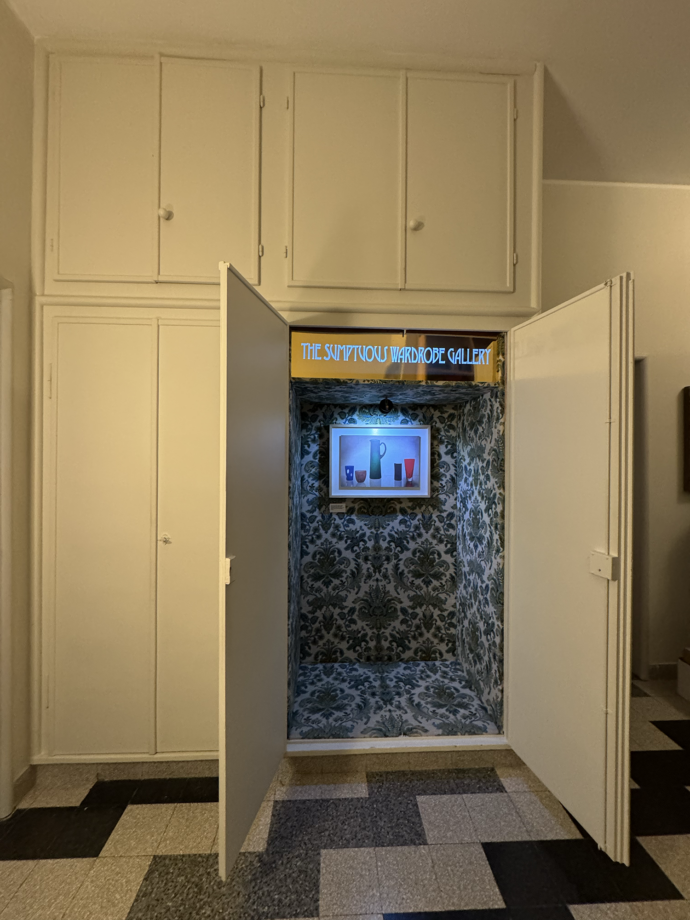
In this work, Pier Giorgio De Pinto transforms a built-in wardrobe in his apartment in Chiasso, Ticino, Switzerland, into a miniature exhibition space. The apartment is located in a building designed by architect Americo Marazzi between 1943 and 1948, whose restrained architectural elegance still preserves the atmosphere of the 1940s.
Originally conceived as a cloakroom for guests, the wardrobe had gradually become an ordinary storage space filled with everyday garments. For the assignment, the artist reactivated the structure by transforming its interior into a micro-gallery.
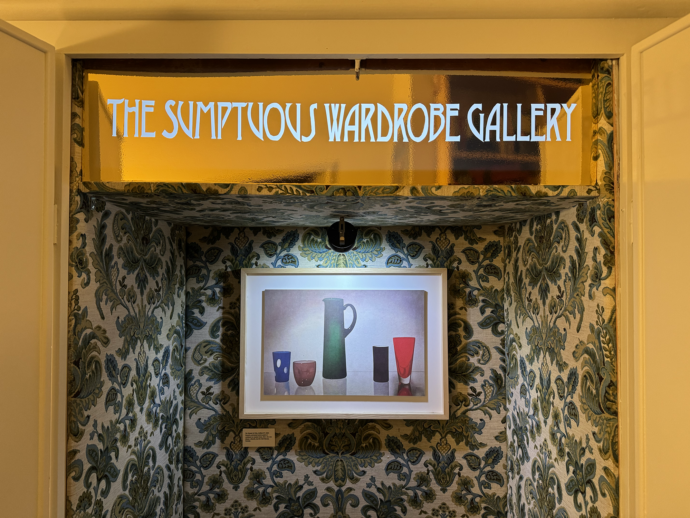
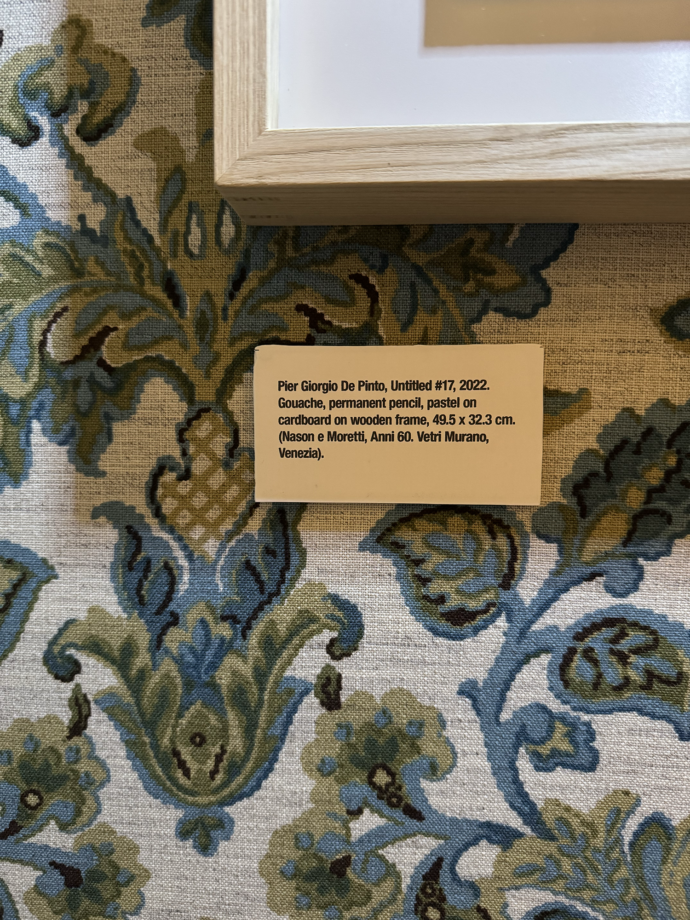
The wardrobe is lined with a floral fabric whose visual language unexpectedly recalls the decorative walls of nineteenth-century museums. At its center De Pinto installed a single framed artwork illuminated by a spotlight and accompanied by a small caption, adopting the codes of institutional display.
Opening the wardrobe doors becomes a performative gesture. What normally remains hidden becomes staged; what belongs to intimacy becomes temporarily visible.
The Sumptuous Wardrobe Gallery proposes the house itself as a potential exhibition architecture, where the rituals of the museum momentarily inhabit the private interior.
Explore the project PDF online, or download it:
The Sumptuous Wardrobe Gallery
- Cartography of Space: Mapping the Studio
(Week 2–3 – The Home as Artwork / Art and Domesticity)
The second work approaches the domestic interior as a spatial system that can be measured, translated, and reinterpreted.
For the assignment Make your house into an artwork, De Pinto transformed his studio into a large-scale drawing. A long strip of white plotter paper was unrolled across the entire floor, sliding beneath objects and furniture until the room was completely covered. On this surface the artist traced the outlines of every object touching the ground.
The result is a 1:1 scale cartography revealing the relationship between positive space (occupied) and negative space (open and walkable). The drawing visualizes the silent choreography governing domestic movement: the way objects are positioned according to gestures, habits, and daily routines.
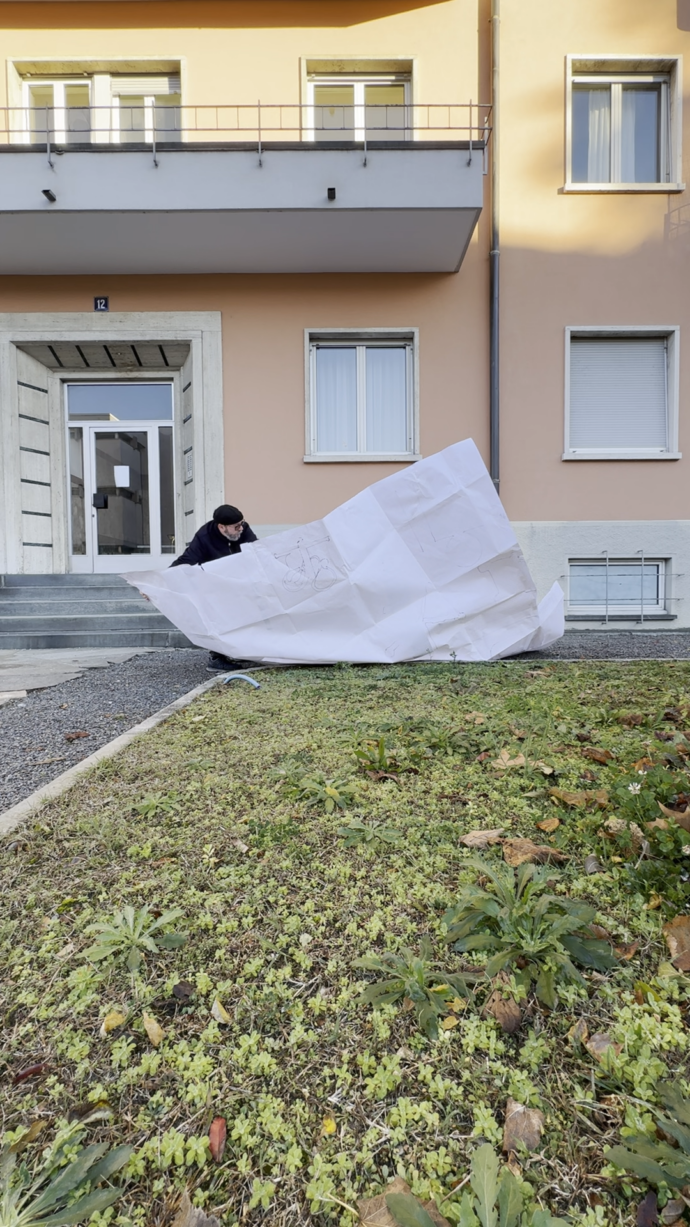
The work then moves beyond the interior. The map is stretched outside the apartment between the window of the studio and the adjacent bedroom window, transforming the private plan of a room into a public sign visible in the urban landscape.
A performative video documents the act of carrying the map outdoors. What was inside becomes outside; the room ceases to function as a container and instead appears as an artwork projected into the city.
Videos
Mapping the objects, forniture and me
Carrying the drawing outside the house and place in front of the building
Explore the project PDF online, or download it:
Cartography of Space: Mapping the Studio
- Threshold Behaviour: A Long-Duration Performance at the Door
(Week 4 – The Body at Home)
For the final weekly assignment, De Pinto activated a specific architectural element of his apartment rather than staging a conventional performance inside the house.
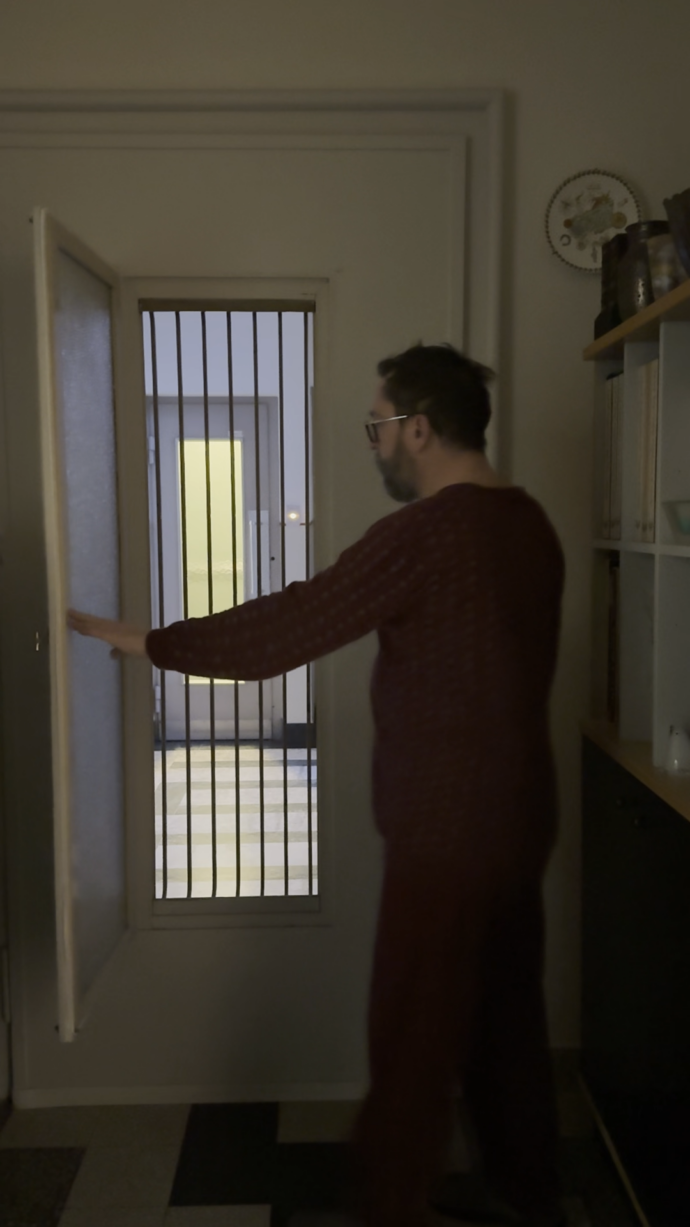
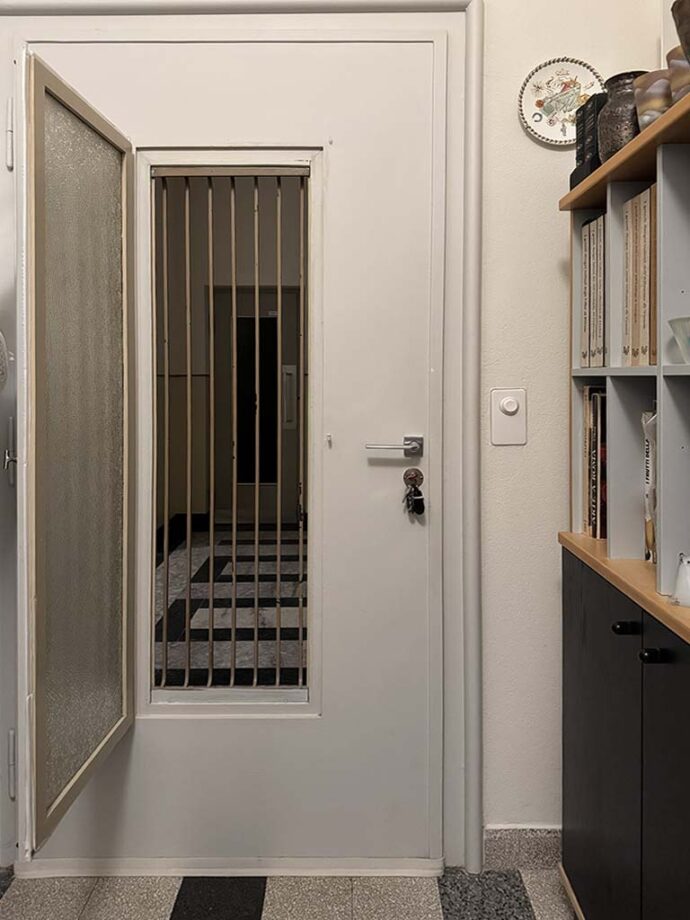
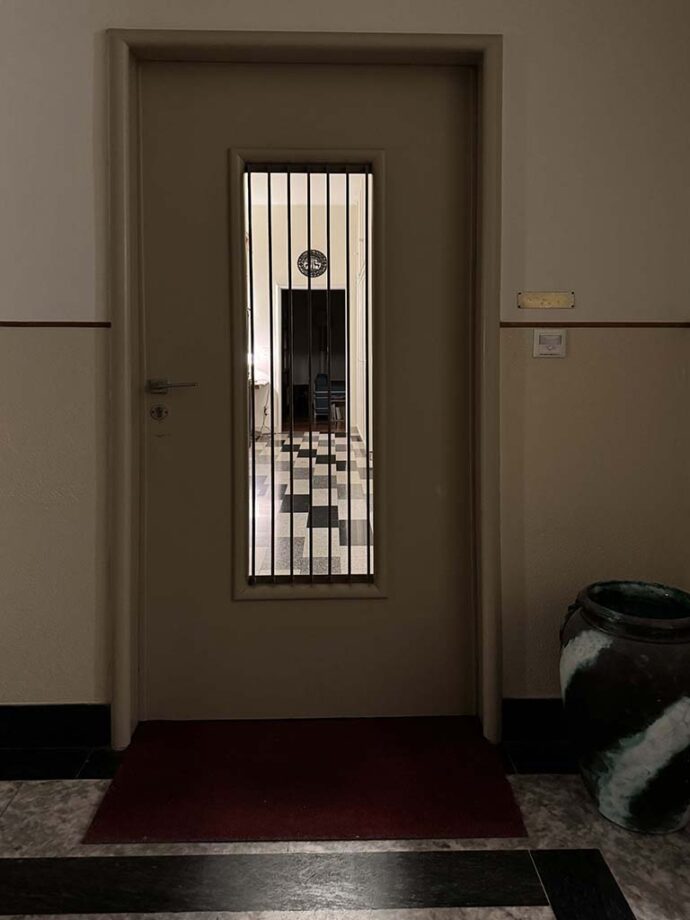
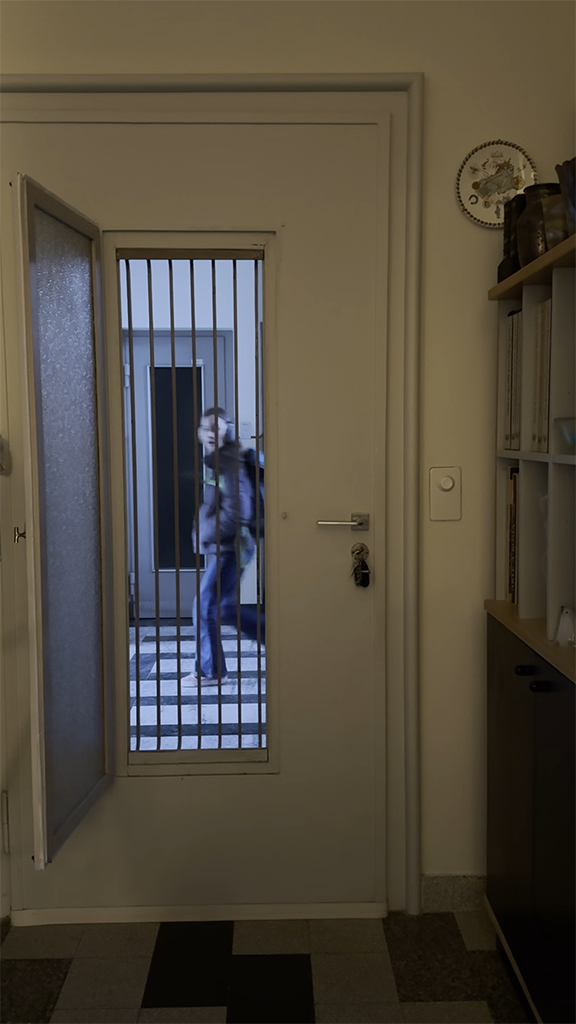
The action focused on the main entrance door of the apartment, built in the 1940s, which contains a small pivoting internal window with frosted glass and a fixed metal grille. This hybrid element; part door, part window, part threshold; became the central device of the performance.
On 27 November 2025, the artist opened this inner window at 7:32 AM and kept it open continuously until 8:00 PM. Throughout the day anyone passing through the building, neighbours, construction workers renovating the upper floors, delivery visitors, and occasional guests, could look directly into the apartment.
Some stared.
Some quickly looked away.
Some slowed down in confusion.
Some asked questions.
Meanwhile, De Pinto continued his daily routine: crossing the hallway in pyjamas after waking up, moving artworks between rooms, cleaning the house, leaving the apartment and returning later in the evening.
During the hours when the artist was away, the house continued the performance without him. The architecture itself became a silent performer.
The open window created a persistent breach in the boundary between domestic interior and public space. The action situates itself between voyeurism and self-exposure, domestic transparency and social anxiety, revealing how fragile and how performative, the concept of privacy becomes when a simple architectural hinge is activated.
Video
Performance Threshold Behaviour
Explore the project PDF online, or download it:
Threshold Behaviour: A Long-Duration Performance at the Door
- Final Project
The Alchemical Home: A Playable Domestic Constellation
As a final development following the four weeks of the course, The Alchemical Home expands De Pinto’s research on domestic space into an interactive and transmedia system.
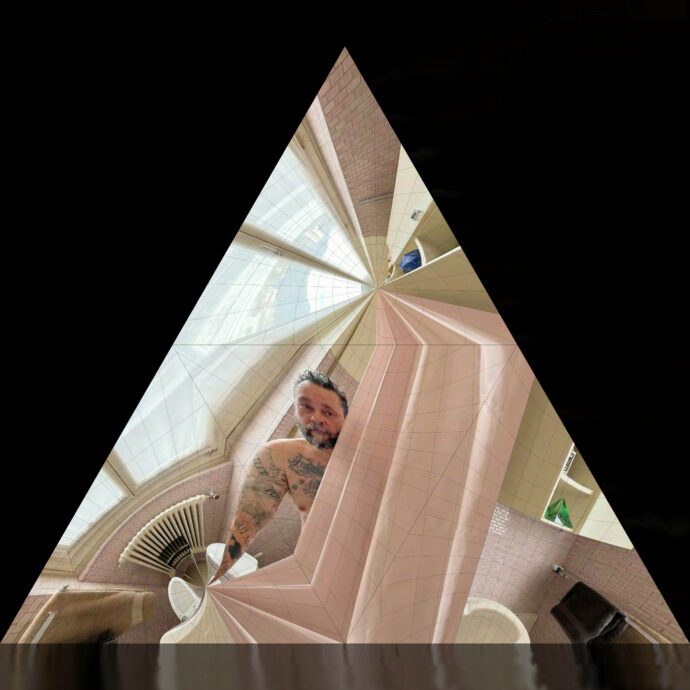
Within the artist’s home, geometric solids inhabit the rooms: resting on shelves, tables, windowsills, and thresholds. These polyhedra function as small “alchemical devices” that subtly shape the perception and experience of space.
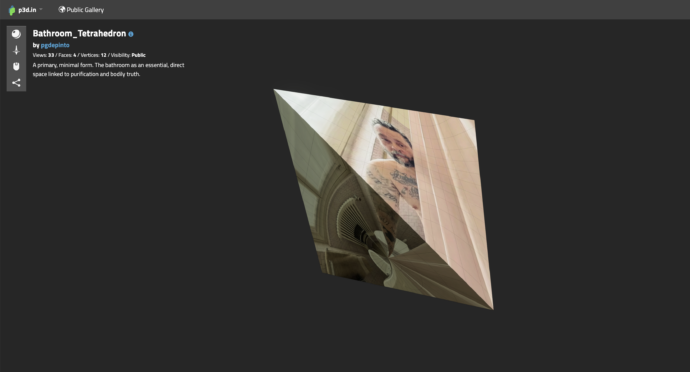
Each room corresponds to a specific polyhedron, translating the domestic interior into a constellation of geometric forms. Through the project PDF, participants can print, cut, and assemble the solids by hand, transforming them into small sculptural objects. By scanning the included QR codes, the same forms can be explored digitally and activated through Augmented Reality.
Using a smartphone or tablet, the polyhedral sculptures can be placed within the viewer’s own environment: enlarged outdoors and explored spatially, or reduced and positioned on intimate surfaces such as a table or bedside.
The house thus becomes a playable constellation unfolding between paper, screen, gesture, and architecture. Domestic space expands beyond its physical boundaries and migrates into new environments.
The project was first presented in March 2026 as part of the group exhibition Floorplan, curated by Rachel Ring at Unit 2 Art Gallery, St Leonards-on-Sea, United Kingdom.
Explore the project PDF online, or download it:
The Alchemical Home: A Playable Domestic Constellation
Closing reflection
Taken together, these works trace a progressive transformation of domestic space: from the hidden micro-architecture of a wardrobe, to the cartographic mapping of an entire room, to the performative activation of an architectural threshold, and finally to the expansion of the home into a distributed constellation of forms.
Through these projects, the domestic interior emerges not simply as a place of habitation, but as a dynamic field where architecture, everyday gestures, and artistic imagination continuously reshape the boundaries between private and public space.